


What To Do With Trees Removed During Fire Mitigation Projects

Across Southwest Colorado, more property owners are taking steps to reduce wildfire risk by creating defensible space around homes, cabins, and ranches. Fire mitigation and forest thinning projects have become an important part of protecting both property and the health of our forests.
After the work is complete, however, many landowners face the same question:
What should be done with the logs?
In many cases, the larger trees removed during mitigation projects are piled, chipped, burned, or hauled away. While those options are sometimes necessary, they often overlook an opportunity to put a valuable natural resource to good use.
Looking Beyond the Slash Pile
Many of the trees removed during fire mitigation projects can be transformed into usable lumber.

Depending on the species, size, and condition of the logs, they may be suitable for fencing, sheds, barns, siding, furniture, paneling, mantels, and a variety of other projects.
Rather than viewing every removed tree as waste, we can begin to see some of these logs as a local building material with value and purpose.
This approach doesn't eliminate the need for mitigation. Instead, it complements it by finding productive uses for a portion of the material already being removed.
Reducing Transportation and Fuel Consumption
One of the often-overlooked environmental costs associated with timber and lumber is transportation.
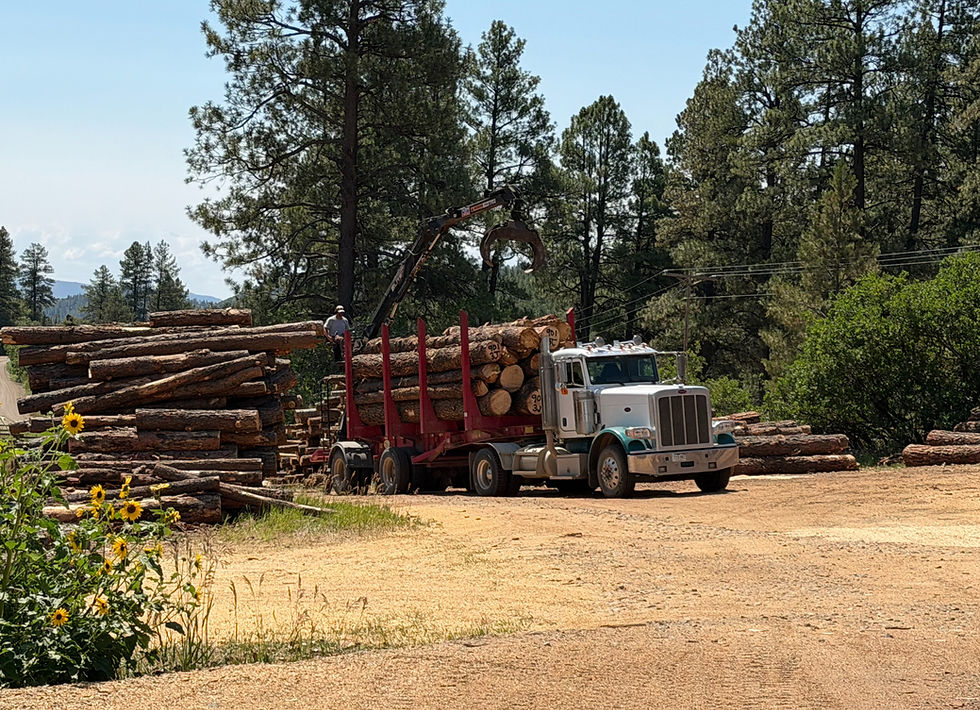
Logs are heavy. Transporting them from a property to a sawmill requires trucks, trailers, fuel, and labor. Once milled, the finished lumber is often transported again before reaching its final destination. Portable sawmilling offers a different approach. By bringing the mill directly to the logs, transportation can be reduced significantly. Instead of hauling multiple large logs off-site, the lumber is produced where the trees grew. This can save fuel, reduce vehicle traffic, lower transportation costs, and simplify logistics for property owners.
Keeping Local Resources Local
Many people are surprised to learn how far lumber often travels before reaching a building site.
Trees may be harvested in one region, processed in another, distributed through multiple channels, and eventually sold hundreds or even thousands of miles from where they originated.
When trees removed during a local mitigation project are milled and used nearby, the resource remains within the community.

A tree that once stood on a property in Southwest Colorado may eventually become fencing, a barn, shelving, a workbench, or lumber for another project on that same property.
There is something meaningful about that connection.
Stewardship and Responsible Use
Good forest stewardship is about more than reducing wildfire risk. It is also about making thoughtful decisions regarding the resources we manage. Not every log is suitable for lumber. Some trees are better suited for firewood, mulch, wildlife habitat, or erosion control. However, when quality logs are available, utilizing them can be a practical way to reduce waste and honor the value of the resource. A tree that took decades to grow deserves consideration before being treated as debris.
A Practical Opportunity for Landowners
If you are planning a fire mitigation project, it may be worth evaluating the larger trees before they are chipped or burned.
You may discover that some of those logs could become useful lumber for future projects on your property.
The result is often a win for the landowner, a reduction in unnecessary waste, and a more thoughtful use of local natural resources.
As wildfire concerns continue to shape the future of Southwest Colorado, finding ways to combine forest health, responsible land management, and resource conservation will become increasingly important. Sometimes the best solution is not simply removing trees, but finding ways to make good use of them once they are removed.
Best
Jason

Comments